Cartridge Heaters Standard Type

Caution
- Download Free! >>Economy Series Catalog ver2023 (TH-EN)_Part22 CLICK here
Product Description
Cartridge Heaters Standard Type
These cartridge heaters are used in various industrial applications to provide localized heat to the equipment. They provide a wide range of sizes to choose from
[Feature]
- Maximum Operating Temperature (°C) : 600
- Diameter (mm.) : 5, 6, 6.25, 8, 10 and 12
- Length (mm.) : 30, 40, 50, 60, 80, 100 and 150
- Voltage(V) : 220
- Material:
Heater - SUS321
[Application]
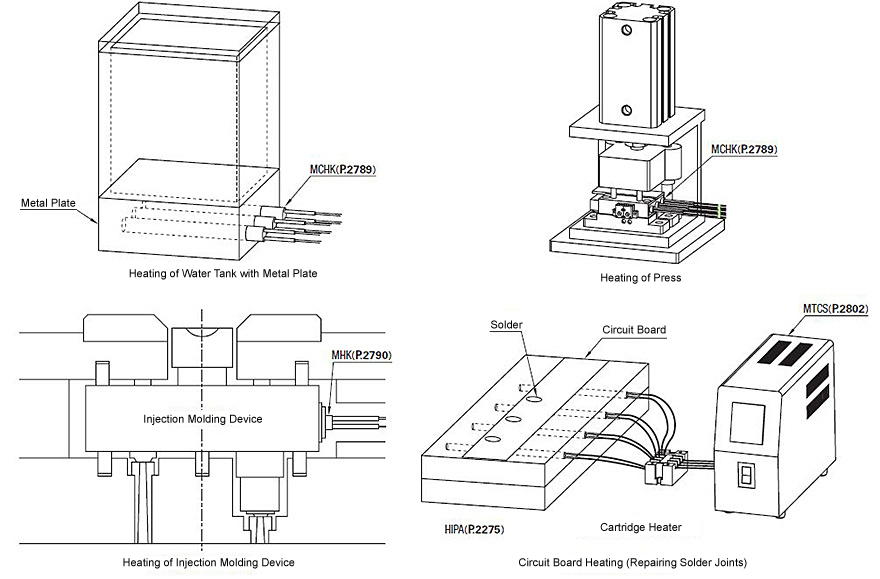
These cartridge heaters are often used in industrial processes such as plastic molding, packaging and sealing.
Economy Cartridge Heater
- Wide Range of Sizes: Available in multiple diameters and lengths to suit a broad spectrum of heating requirements.
- Multiple Wattage Options: Select from a range of power outputs.
- Durable SUS321 Construction: Built to last, the heater body resists corrosion and ensures a long service life.
- 220V Compatibility: Integrate seamlessly with existing electrical setups in your facility.
- Fast and Efficient Heating: The compact design ensures efficient heat transfer directly to the target object, minimizing energy waste.


MISUMI Standard

Cheaper Price

Product Variety

3D CAD Support
Cartridge Heaters Product Overview
The Cartridge Heaters is a durable and highly versatile product. It is widely used in heavy-industry applications such as plastics and packaging, emergency care medical equipment and analytical test instruments in aircrafts, train compartments and trucks, etc.
It can serve as a thermally conductive source for heating solid metal plates, modules and molds, and a convective heat source for various liquids and gases.
Cartridge Heaters Product Feature
● It is a long-life and high-power Cartridge Heaters, most suitable for heating purposes, mainly heating metal plates.
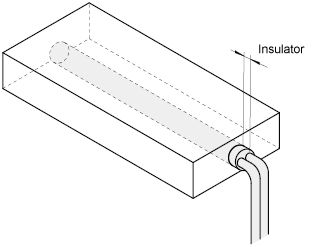
● The maximum operating temperature is the temperature of the heating part. Please pay attention to the heat-resistant temperature of the lead wire, and the insulator and lead wire must be drawn out from the mounting hole.

■ Difference between MISUMI Economy series and generic products in the market
| Cartridge Heaters Products circulating on the market * | MISUMI economy series | |
| Service life test equivalent to 4,000 H* | 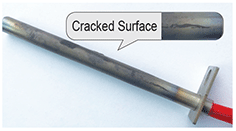 | 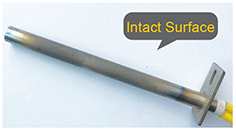 |
| Result | Cannot be used due to short circuit or breakage | Can be used normally |
* Generic Cartridge Heaters products in the market are similar products randomly purchased by our company from online or offline markets
* The test data are obtained through testing by our company, which are for reference only
Cartridge Heaters Dimensional Drawing
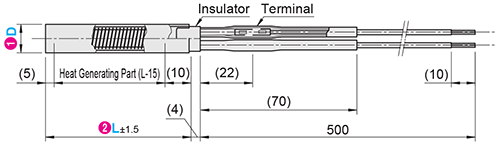
*Do not insert the heating rod completely into the hole, ensure that the insulator partially protrudes from the surface of the workpiece.
D Tolerance * The tolerance is the value of the heating part
| D(mm) | Tolerance (mm) |
| 5~12 | -0.03 -0.06 |
 Cartridge Heaters Maximum operating temperature: 600℃Lead wire heat-resistant temperature: 260℃
・Material table
 Material
Body: SUS321
Lead wire: Nickel (Ni)
Lead wire coating: PTFE
Example of Cartridge Heaters Use
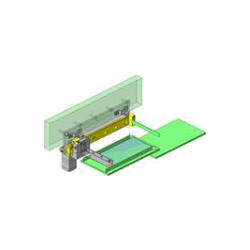 | 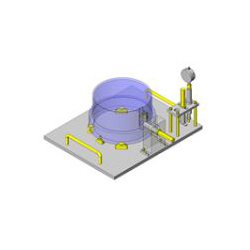 | 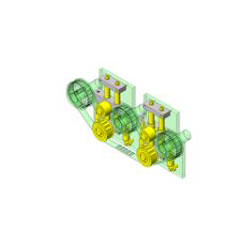 |
| Cartridge Heaters Move parts related to mechanism sliding support, temperature adjusting and heating with racks, gears and other workpieces. | Check 3 types of parts related to the sliding support, temperature adjusting and heating in the same position. | Belt tension device (with the spring) |
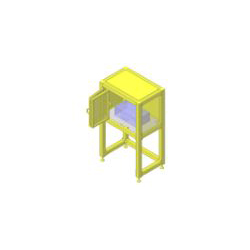 | 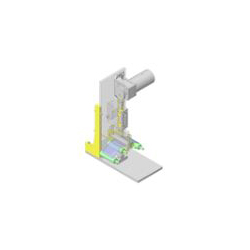 | 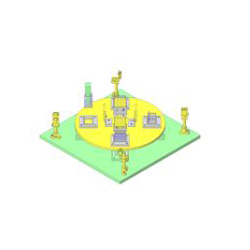 |
| Parts related to the sliding support, nut, profile, temperature adjusting and heating | Slide up and down through clamping & welding parts of the cam bearing mechanism | No need to worry about handling of inductor wiring even for reversely rotating objects |
For more examples of Cartridge Heaters product use, please refer to
//th.misumi-ec.com/en/asia/incadlibrary/keyword.html?keyword=%E7%AD%92%E5%BC%8F%E5%8A%A0%E7%83%AD%E5%99%A8¤tPage=1.
Cartridge Heaters Precautions
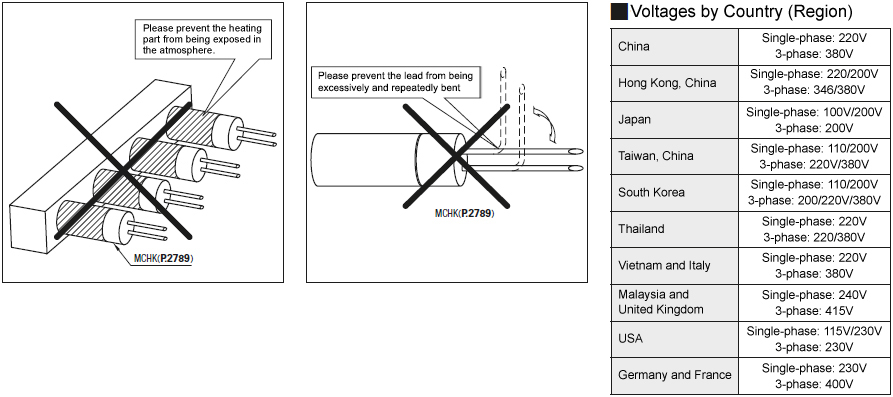
① Do not let the heater dry burn in the atmosphere. Otherwise, even if only heating part of the Cartridge Heaters is exposed outside the object heated, the wire may break and cause a fire due to abnormal heating.
② Do not let the lead wire and insulator of the heater come into contact with water. Otherwise, it may cause electric leakage or short circuit.
③ The oil and grease used for processing holes in the heated part should be removed. Otherwise, abnormal heat may be generated due to carbonization.
④ An abnormally short ON-OFF cycle may have an adverse effect on the service life of the heater. It is recommended to use a controller controlled by PID.
⑤ The nickel pin at the root of the lead wire may be broken after being bent repeatedly.
⑥ Do not use a power supply with the voltage exceeding the rated voltage (V).
⑦ When removing the heater from the object heated, make sure to turn off the power first. Do not touch the heater immediately after turning off the power.
⑧ The temperature around the lead wire outlet shall be kept below 130℃.
⑨ When the flanged heater is used, the temperature around the flange shall be kept below 180°C.
⑩ Do not use it in the vacuum.
⑪ When heating, the heater will expand and may cause the heat-generating part to protrude from the mounting hole. It is recommended to fix the heater with screws.
⑫ Choose a voltage that is suitable for the operating environment. If you use a voltage that exceeds the rated value, the heater may be damaged.
* Other precautions for each type of cartridge heaters are recorded on each product page. Please make sure to follow the above precautions and operate the heater properly.
Specifications Cartridge Heaters Overview
① Determine the required heater heat (W).
It can be calculated with the following formula according to the mass, specific heat, rising temperature, and the heating time required to reach the set temperature of the object heated.

The efficiency varies with the heat preservation, thermal insulation, and settings of the heater, so it is difficult to calculate it correctly. Generally, the value of about 0.2 to 0.5 is preferred.

② Determine the number of Cartridge Heaters and the heat of each heater (W).
The number of heaters is subject to the size of the object heated, and the total heat (W) is the heat required by the object heated.
Example) Use 2 heaters of 550 (W) (1,100 W in total).
● Selection of the cartridge heater (P.2789 MCHK type)
| ① Determine the diameter and length of the heater | ② Determine the voltage (V) to be used | ③ Determine the heat (W) required for the object heated |
 |  |  |
Note: For the power (W) of the L Dimension ・W (Power) Fixed Type, please select a product with the power (W) larger than the required heat (W).

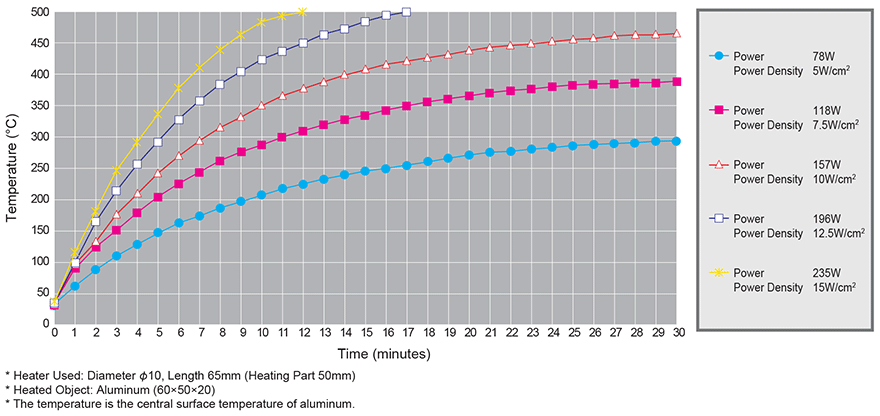
● Measurement data of the temperature rise time by power
Cartridge Heaters Related Products
■Overview
・The common specifications of MISUMI heaters have been standardized, which can satisfy the users’ needs of shortening the delivery time.
・ The temperature sensor and temperature controller, etc. required to control the heater can also be selected from the catalog.
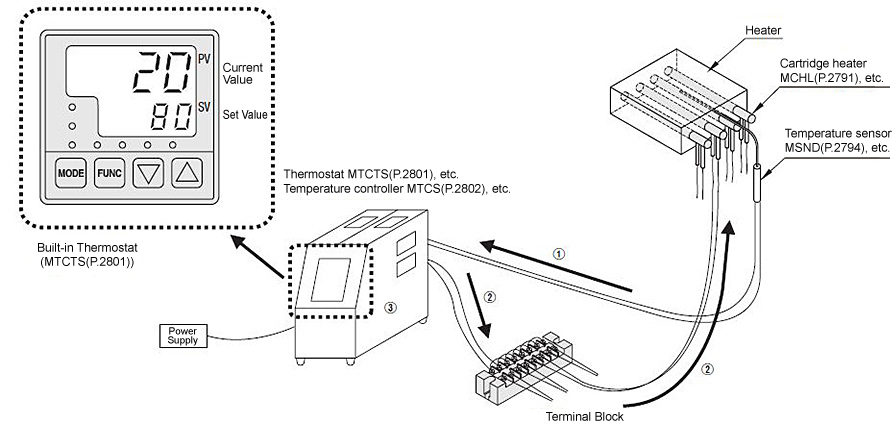
■Basic structure (example)
・As shown in the figure below, the heater shall be used in combination with the temperature sensor and temperature controller.
・ Temperature adjusting procedure
■ Example of Cartridge Heaters use
① The temperature detected by the temperature sensor is regarded as the current value (PV) of the temperature controller.
② As shown in the above basic structure (an example), when the set temperature (SV) of the temperature controller is 80°C and the current value (PV) is 20°C, the temperature controller will apply a voltage (ON) to enable heating-up of the heater.
③ If the voltage (ON) is maintained all the time, the temperature will exceed the set value (SV) of 80°C. Therefore, when the temperature rises to around the set value (SV) 80°C, the temperature controller will stop applying the voltage (OFF).
When the current value of the temperature (PV) is
Cartridge Heaters Usage Method
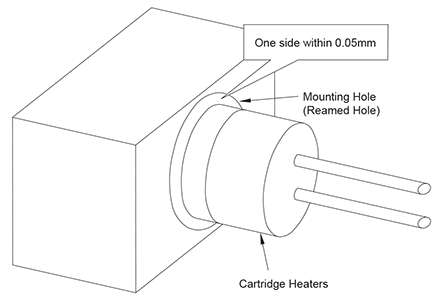
● Please minimize the mounting hole gap of the heated metal block as much as possible.
When the metal block mounting hole is machined, it is recommended to keep the gap below 0.05 on one side.
* The size of gap between the heater and object heated will affect the service life of the heater. When a large gap will extend, a drilling hole can be used, but it is recommended that all heaters use reamed mounting holes. The temperature rise time may cause the response speed of the temperature controller to slow down. The temperature of the object heated is controlled below 300°C.
* The service life of the heater may change greatly due to the environment. The improper operating temperature and temperature adjusting method may cause wire breakage in a short period of time. Therefore, it is recommended to prepare the backup cartridge heater.
| Part Number | Diameter (D) mm | Length (L) mm | Rated Capacity W | Rated Voltage V | Power Density W/cm² |
| Standard Type | 5 | 30 | 40 | 220 | 8.5 |
| 40 | 40 | 220 | 6.4 | ||
| 40 | 60 | 220 | 9.6 | ||
| 50 | 50 | 220 | 6.4 | ||
| 60 | 100 | 220 | 10.6 | ||
| 80 | 150 | 220 | 11.9 | ||
| 6 | 30 | 50 | 220 | 8.8 | |
| 40 | 80 | 220 | 10.6 | ||
| 50 | 100 | 220 | 10.6 | ||
| 60 | 130 | 220 | 11.5 | ||
| 80 | 100 | 220 | 6.6 | ||
| 80 | 200 | 220 | 13.2 | ||
| 6.25 | 60 | 50 | 220 | 4.2 | |
| 100 | 120 | 220 | 6.1 | ||
| 8 | 30 | 60 | 220 | 8 | |
| 50 | 100 | 220 | 8 | ||
| 50 | 150 | 220 | 11.9 | ||
| 100 | 200 | 220 | 8 | ||
| 100 | 350 | 220 | 13.9 | ||
| 10 | 50 | 120 | 220 | 7.6 | |
| 100 | 400 | 220 | 12.7 | ||
| 12 | 100 | 300 | 220 | 8 | |
| 150 | 500 | 220 | 8.8 |