Fluoropolymer Tubing (FEP) TH/TIH Series
Caution
- The maximum operating pressure values listed are at 20°C. See the catalog for details.
- For specifications and details, please refer to the catalog.
Product Description
A fluoropolymer tubing with superior durability in chemical environments.
[Features]
· Compatible with Japan's Food Sanitation Law.
· Operating temperature: 200°C (varies depending on the conditions).
· RoHS compliant.
· Maximum operating pressure 2.3 MPa or less (at 20°C) (varies by size).
· Complies with the FDA (Food and Drug Administration) §177-1550 dissolution test.
Specifications Of Fluoropolymer Tubing (FEP) TH/TIH Series

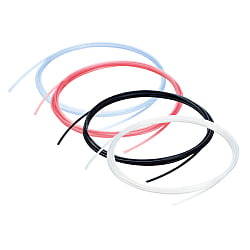
Appearance of Fluoropolymer Tubing (FEP) TH/TIH Series
Color
- Translucent: N
- Red (translucent): R
- Blue (translucent): BU
- Black (translucent): B
Metric Sizes TH Series

Maximum operating pressure
Note) The maximum operating pressure varies depending on the inner diameter bore size even if the outer diameter is the same.

How to measure the minimum bending radius
Bend the tubing into a U shape at a temperature of 20°C. Fix one end and close the loop gradually. Measure 2R when the deformed ratio of the tubing diameter at bending reaches 5%.
| - | Metric Size | |||||||
|---|---|---|---|---|---|---|---|---|
| Nominal | TH0402 | TH0425 | TH0604 | TH0806 | TH1075 | TH1008 | TH1209 | TH1210 |
| Outer diameter mm | 4 | 4 | 6 | 8 | 10 | 10 | 12 | 12 |
| Inner diameter (mm) | 2 | 2.5 | 4 | 6 | 7.5 | 8 | 9 | 10 |
Specifications
| Fluid | Air, waterNote 1), inert gas | ||||||||
|---|---|---|---|---|---|---|---|---|---|
| Applicable fittingsNote 2) | One-touch fittings Insert fittings Fluoropolymer fittings: LQNote 3) Series Miniature fittings: M, MS Series (Hose-nipple type) | ||||||||
| Maximum operating pressure (MPa) | 20°C | 2.3 | 1.7 | 1.5 | 1 | 0.7 | 1 | 0.7 | |
| 100°C | 0.85 | 0.6 | 0.55 | 0.4 | 0.25 | 0.4 | 0.25 | ||
| 200°C | 0.4 | 0.3 | 0.3 | 0.2 | 0.1 | 0.2 | 0.1 | ||
| Refer to the maximum operating pressure curve. | |||||||||
| Minimum bending radius mmNote 4) | Recommended radius | 15 | 20 | 35 | 60 | 95 | 100 | 130 | |
| Tube close bend radius | 10 | 15 | 20 | 40 | 60 | 65 | 110 | ||
| Operating temperature | Air, inert gas: -20 to 200°C / Water: 0 to 100°C (No freezing) | ||||||||
| Material | FEP (Fluorinated Ethylene Propylene Resin) | ||||||||
Note 1) When using a liquid fluid, the surge pressure must be under the maximum operating pressure. If the surge pressure exceeds the maximum operating pressure, it will result in damage to the fittings and tubing. Furthermore, abnormal temperature rise caused by adiabatic compression may result in the tubing bursting.
Note 2) Do not use in locations where the FEP tubing will move. Be sure to operate under the maximum operating pressure and maximum operating temperature conditions using the lower maximum operating specification of either the tubing or fittings. A material change over a long duration or due to high temperature may cause leakage. Perform periodic maintenance and replace with a new product immediately when abnormalities are detected. When the insert and miniature fittings are used over extended periods of time, it may cause leakage due to age-related material deterioration. In such a case, apply additional tightening to the tube connection part. If leakage still occurs after applying additional tightening, replace the fitting with a new product. For other precautions, refer to "Fittings & Tubing Precautions" in the catalog. When using the fluoropolymer fittings, refer to the precautions in the catalog. Select the size after confirming the outer diameter and inner diameter.
Note 3) TH0402, TH0425, TH1075 and TH1209 are not available because of different internal diameters.
Note 4) The minimum bending radius is the value measured as shown in the above figure ("How to measure the minimum bending radius").
- Use a tube above the recommended minimum bending radius.
- The tubing may be bent if used under the recommended minimum bending radius. Therefore, refer to the tube close bend radius and make sure that the tubing is not bent or flattened.
- The tube close bend radius is not guaranteed. The value of 2R is the value measured with a flattened tube using the method shown in the above figure ("How to measure the minimum bending radius").
Inch Sizes TIH Series

Maximum operating pressure
Note) The maximum operating pressure varies depending on the inner diameter bore size even if the outer diameter is the same.

How to measure the minimum bending radius
Bend the tubing into a U shape at a temperature of 20°C. Fix one end and close the loop gradually. Measure 2R when the deformed ratio of the tubing diameter at bending reaches 5%.
| - | Inch Size | |||||||||||
|---|---|---|---|---|---|---|---|---|---|---|---|---|
| Nominal | TIHA01 | TIHB01 | TIHC01 | TIHA05 | TIHB05 | TIHA07 | TIHB07 | TIHA11 | TIHB11 | TIH13 | TIH19 | |
| Outer diameter | inch | 1/8 " | 3/16 " | 1/4 " | 3/8 " | 1/2 " | 3/4 " | |||||
| mm | 3.18 | 4.75 | 6.35 | 9.53 | 12.7 | 19.05 | ||||||
| Inner diameter | inch | 0.093 " | 0.086 " | 0.065 " | 0.137 " | 0.124 " (1/8 ") | 0.18 " | 0.156 " (5/32 ") | 0.275 " | 0.25 " (1/4 ") | 0.374 " (3/8 ") | 0.624 " (5/8 ") |
| mm | 2.36 | 2.18 | 1.65 | 3.48 | 3.15 | 4.57 | 3.95 | 6.99 | 6.33 | 9.5 | 15.85 | |
Specifications
| Fluid | Air, waterNote 1), inert gas | |||||||||||
|---|---|---|---|---|---|---|---|---|---|---|---|---|
| Applicable fittingsNote 2) | One-touch fittings Insert fittings Fluoropolymer fittings: LQNote 3) Series | |||||||||||
| Maximum operating pressure (MPa) | 20°C | 1 | 2.3 | 1 | 1.5 | 1 | 1.7 | 1 | 1.5 | 1 | 0.7 | |
| 100°C | 0.4 | 0.85 | 0.4 | 0.55 | 0.4 | 0.6 | 0.4 | 0.55 | 0.4 | 0.25 | ||
| 200°C | 0.2 | 0.4 | 0.2 | 0.3 | 0.2 | 0.3 | 0.2 | 0.3 | 0.2 | 0.1 | ||
| Refer to the maximum operating pressure curve. | ||||||||||||
| Minimum bending radius mmNote 4) | Recommended radius | 25 | 20 | 10 | 35 | 25 | 55 | 35 | 85 | 60 | 95 | 220 |
| Tube close bend radius | 20 | 12 | 7 | 25 | 20 | 35 | 20 | 55 | 30 | 60 | 160 | |
| Operating temperature | Air, inert gas: -20 to 200°C / Water: 0 to 100°C (No freezing) | |||||||||||
| Material | FEP (Fluorinated Ethylene Propylene Resin) | |||||||||||
Note 1) When using a liquid fluid, the surge pressure must be under the maximum operating pressure. If the surge pressure exceeds the maximum operating pressure, it will result in damage to the fittings and tubing. Furthermore, abnormal temperature rise caused by adiabatic compression may result in the tubing bursting.
Note 2) Do not use in locations where the FEP tubing will move. Be sure to operate under the maximum operating pressure and maximum operating temperature conditions using the lower maximum operating specification of either the tubing or fittings. A material change over a long duration or due to high temperature may cause leakage. Perform periodic maintenance and replace with a new product immediately when abnormalities are detected. When the insert and miniature fittings are used over extended periods of time, it may cause leakage due to age-related material deterioration. In such a case, apply additional tightening to the tube connection part. If leakage still occurs after applying additional tightening, replace the fitting with a new product. For other precautions, refer to "Fittings & Tubing Precautions" in the catalog. When using the fluoropolymer fittings, refer to the precautions in the catalog. Select the size after confirming the outer diameter and inner diameter.
Note 3) TIHA01, TIHC01, TIHA05, TIHA07 and TIHA11 are not available because of different internal diameters.
Note 4) The minimum bending radius is the value measured as shown in the above figure ("How to measure the minimum bending radius").
- Use a tube above the recommended minimum bending radius.
- The tubing may be bent if used under the recommended minimum bending radius. Therefore, refer to the tube close bend radius and make sure that the tubing is not bent or flattened.
- The tube close bend radius is not guaranteed. The value of 2R is the value measured with a flattened tube using the method shown in the above figure ("How to measure the minimum bending radius").