[Clean & Pack]Stopper Bolt with Urethane Bumper - Shoulder Type, Standard

Brand :
MISUMI
Caution
- Cleaning also removes rust prevention oil, which may make the product more susceptible to rusting than an uncleaned product.
Please be careful about the application location and storage environment.
Product Description
Three types of cleaning methods are available: degreasing, precision cleaning, and electrolytic polishing + precision cleaning. They can be ordered from one piece with the standard part number.
This eliminates the need for customer cleaning or outsourced cleaning, reducing the amount of time and effort required.
This eliminates the need for customer cleaning or outsourced cleaning, reducing the amount of time and effort required.
■Part Number for Clean & Pack Products
| · Degreasing (Anti-rust single packing) | : Part Number SL-** |
| · Precision cleaning (Degassing double packing) | : Part Number SH-** |
| · Electrolytic polishing + precision cleaning (Degassing double packing) | : Part Number SHD-** |
| Product Part Number | Cleaning Method | Packaging Type | Effects Compared to Uncleaned Product | Environment (Standard) | Process |
| SL-** | Degreasing | Anti-rust packing | Oil removal | General environment | Regular assembly process |
| Post battery assembly process | |||||
| SH-** | Precision cleaning | Degassing double packing | Oil removal Dust removal | Clean environment (Class 10 to 1,000) | Battery assembly process |
| LCD-related post assembly process | |||||
| In-vehicle camera assembly process | |||||
| SHD-** | Electrolytic polishing + precision cleaning | Degassing double packing | Oil removal Dust removal Outgas reduction | Vacuum environment Clean environment (Class 10 to 1,000) | Pre-semiconductor process |
| Liquid crystal deposition process | |||||
| Pre-OLED process |
■Notes
Cleaning also removes rust prevention oil, which may make the product more susceptible to rusting than an uncleaned product.
Please be careful about the application location and storage environment.
Cleaning also removes rust prevention oil, which may make the product more susceptible to rusting than an uncleaned product.
Please be careful about the application location and storage environment.
Standard Straight Shape
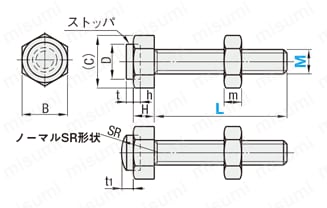
[ ! ] Incomplete threaded portion of 2 x pitch is under the neck.
[ ! ] Incomplete threaded portion of 2 x pitch is under the neck.
| M (Coarse) | D | B | (C) | H | h | t | t1 | m |
| 3 | 3.5 | 5.5 | 6.4 | 2 | 0.7 | 1.5 | 2 | 1.8 |
| 4 | 5 | 7 | 8.1 | 2.8 | 1.5 | 2.2 | 2.4 | |
| 5 | 6 | 8 | 9.2 | 3.5 | 2.3 | 3.2 | ||
| 6 | 8 | 10 | 11.5 | 4 | 2 | 2 | 2.6 | 3.6 |
| 8 | 10 | 13 | 15 | 5.5 | 2.8 | 5 | ||
| 10 | 13 | 17 | 19.6 | 7 | 3.2 | 6 | ||
| 12 | 15 | 19 | 21.9 | 8 | 3.5 | 7 |
| Standard Type | [ M ] Material | Resin, rubber | Cleaning Method | ||||||
| Straight Shape | Stopper | Screw | [ A ]Accessory (Hex nut) | How to mount | Cleaning Method | Cleaning Environment | Packaging Type | Packing Environment | |
| SL-SSTS | Silicon (light gray) | Shore A70 | SUS304 | SUS304 Equivalent | Fused | Degreasing | General environment | Anti-rust packing | General environment |
| SH-SSTS | Precision cleaning | Class 1,000 | Degassing double packing | Class 10 | |||||
[ ! ] See the
 details of degreasing, precision cleaning, and electrolytic polishing shown at the bottom of the specification table.
[ ! ] Only the urethane stopper part at the tip is not sold. (Standard products are not available)
*About bolt strength class (>>Here)
Part Number Display Method
| Part Number | - | L |
| SL-SSTS8 | - | 40 |
| SH-SSTS6 | - | 30 |
Specification Table
| Part Number | L Selection | ||||||||||
| Type | M (Coarse) | ||||||||||
| SL-SSTS SH-SSTS | 4 | 15 | 20 | 25 | 30 | 35 | 40 | ||||
| 5 | 15 | 20 | 25 | 30 | 35 | 40 | 45 | 50 | |||
| 6 | 20 | 25 | 30 | 35 | 40 | 45 | 50 | 60 | |||
| 8 | 20 | 25 | 30 | 35 | 40 | 45 | 50 | 60 | |||
Selection Supporting Information
| Mass (g) Reference Value | Part Number | |
| M | L | SL-SSTS SH-SSTS |
| 4 | 15 | 2 |
| 20 | 3 | |
| 25 | 3 | |
| 30 | 3 | |
| 35 | 4 | |
| 40 | 4 | |
| 5 | 15 | 4 |
| 20 | 4 | |
| 25 | 5 | |
| 30 | 6 | |
| 35 | 6 | |
| 40 | 15 | |
| 45 | 7 | |
| 50 | 8 | |
| 6 | 20 | 7 |
| 25 | 8 | |
| 30 | 8 | |
| 35 | 9 | |
| 40 | 11 | |
| 45 | 11 | |
| 50 | 12 | |
| 60 | 13 | |
| 8 | 20 | 15 |
| 25 | 16 | |
| 30 | 18 | |
| 35 | 19 | |
| 40 | 21 | |
| 45 | 23 | |
| 50 | 25 | |
| 60 | 27 | |
Cautions/prohibitions
Tightening shaft force and fatigue limit when fastening with bolts
- Calculation of the appropriate tightening axial force when tightening bolts should be within the elastic range of up to 70% of the specified capacity for the torque method.
- The fatigue strength of the bolt due to repeated loading should not be over the allowable value.
- The objects tightened should not be caved in on the bolt and nut seating surfaces.
- The objects tightened should not be damaged due to tightening.
The torque method, torque gradient method, angle of rotation method, and elongation measurement method are available as bolt tightening methods, but the torque method is widely used because it is simple and easy to use.
Technical information
Bolt strength
1) When bolt is subjected to tensile load
Pt = σt x As:: (1)
=πd2σt/4: (2)
Pt = σt x As:: (1)
=πd2σt/4: (2)
Pt: Axial direction tensile load [N]
σb: Yield stress of bolts [N/mm2]
σt: Allowable stress of bolts [N/mm2]
(σt = σb/safety factor α)
As: Effective cross sectional area of bolts [mm2]
As = πd2/4
d: Effective diameter of bolts (root diameter)[m]
σb: Yield stress of bolts [N/mm2]
σt: Allowable stress of bolts [N/mm2]
(σt = σb/safety factor α)
As: Effective cross sectional area of bolts [mm2]
As = πd2/4
d: Effective diameter of bolts (root diameter)[m]
(Example) Find the appropriate size for a single hex socket head cap bolt to repeatedly (pulsating) receive a tensile load of P = 1,960 N {200 kgf}. (The hex socket head cap screw is made of SCM435, 38 to 43 HRC, and has a strength class of 12.9.)
(1) From the equation
As = Pt/σt = 1,960/219.6 = 8.9 [mm2]
∴It is recommended to find an effective cross sectional area larger than this from the "Bolt Fatigue Strength" table below and select M5 of 14.2 [mm2].
In consideration of fatigue strength, select M6 with an allowable load of 2,087 N {213 kgf} from strength class 12.9 in the table.

2) When receiving tensile impact loads, such as stripper bolts, select based on fatigue strength. (Similarly, the stripper bolt that receives a load of 1,960 N {200 kgf} is made of SCM435, 33 to 38 HRC, and has a strength class of 10.9.)
According to the table "Fatigue Strength of Bolts" below, when the allowable load for strength class 10.9 is 1,960 N {200 kgf} or more, the M8 is 3,116 [N] {318 [kgf]}. Therefore, MSB10 with a shaft diameter of 10 mm with an M8 threaded section is selected. When the bolt is subjected to shear load, use a dowel pin in combination.
According to the table "Fatigue Strength of Bolts" below, when the allowable load for strength class 10.9 is 1,960 N {200 kgf} or more, the M8 is 3,116 [N] {318 [kgf]}. Therefore, MSB10 with a shaft diameter of 10 mm with an M8 threaded section is selected. When the bolt is subjected to shear load, use a dowel pin in combination.
■Unwin safety factor α based on tensile strength
| Material | Static load | Repeated load | Impact load | |
|---|---|---|---|---|
| Pulsating | Alternating | |||
| Steel | 3 | 5 | 8 | 12 |
| Cast iron | 4 | 6 | 10 | 15 |
| Copper, soft metals | 5 | 5 | 9 | 15 |
Allowable stress = standard strength / safety factor α
Standard strength: Yield stress for ductile materials (fracture stress for brittle materials)
The yield stress of strength class 12.9 is σb = 1,098 [N/mm2] {112 [kgf/mm2] }
Allowable stress σt = σb/safety factor (safety factor 5 from the above table "Unwin Safety Factor α Based on Tensile Strength")
=1,098/5
=219.6 [N/mm2] {22.4 [kgf/mm2] }
■Bolt fatigue strength (for screws > > fatigue strength of 2 million cycles)
Fatigue strength* is extracted from "Estimated Fatigue Limits for Metric Threads for Machine Screws, Bolts, and Nuts" (Yamamoto) and revised.
| Nominal of thread | Effective cross sectional area As mm2 | Strength class | |||
|---|---|---|---|---|---|
| 12.9 | 10.9 | ||||
| Fatigue strength * | 12.9 | 10.9 | 10.9 | ||
| N/mm2 {kgf/mm2} | N {kgf} | N/mm2 {kgf/mm2} | N {kgf} | ||
| M4 | 8.78 | 128 {13.1} | 1117 {114} | 89 {9.1} | 774 {79} |
| M5 | 14.2 | 111 {11.3} | 1568 {160} | 76 {7.8} | 1088 {111} |
| M6 | 20.1 | 104 {10.6} | 2087 {213} | 73 {7.4} | 1460 {149} |
| M8 | 36.6 | 87 (8.9) | 3195 (326) | 85 (8.7) | 3116 (318) |
| M10 | 58 | 73 {7.4} | 4204 (429) | 72 (7.3) | 4145 (423) |
| M12 | 84.3 | 66 (6.7) | 5537 (565) | 64 (6.5) | 5370 (548) |
| M14 | 115 | 60 (6.1) | 6880 (702) | 59 {6} | 6762 {690} |
| M16 | 157 | 57 {5.8} | 8928 {911} | 56 {5.7} | 8771 {895} |
| M20 | 245 | 51 {5.2} | 12485 {1274} | 50 {5.1} | 12250 {1250} |
| M24 | 353 | 46 {4.7} | 16258 {1659} | 46 {4.7} | 16258 {1659} |