Linear Shafts Both Ends Tapped with Wrench Flats

Brand :
MISUMI
Caution
- Download Free! >> Economy Series Catalog (TH-EN-FY25) CLICK here
Product Description
[Features]
• Linear guide shaft for use with linear bushings and other bushing-type products.
• High-frequency quenched materials and hard chrome plating options help match wear or rust-prevention needs.
• L can be specified in 1 mm increments, with selectable coarse threads and wrench slot size.
[Use]
• Used in linear motion mechanisms for medical, semiconductor, electronic, smartphone, food and automobile equipment.
Product Overview
Linear guide shafts are high-precision shaft products that can be used with linear bushings and other bushing-type products. They not only offer excellent wear resistance, but also provide a variety of additional machining options.
Dimensional Drawing

Specification Overview
| Type |  Material Material |  Hardness Hardness |  Surface Treatment Surface Treatment | |
| With Wrench Slot Type | ||||
| Standard | ||||
| D tolerance g7 | D tolerance f8 | |||
| E-SFJZ | - | S45C or GCr15 | High-frequency quenching Effective hardened layer depth>>See (PDF) S45C or GCr15 55HRC~ SUS440C or equivalent high-hardness corrosion-resistant steel 53HRC or more | - |
| E-SSFJZ | - | SUS440C or high-hardness corrosion-resistant steel | ||
| E-PSFJZ | - | S45C or GCr15 | Hard Chrome Plating Plating Hardness HV750~ Plating Thickness 3µ or more | |
| E-PSSFJZ | - | SUS440C or high-hardness corrosion-resistant steel | ||
| - | E-PSFGZ | S45C Equivalent | - | Hard Chrome Plating Plating Hardness HV750~ Plating Thickness 10µ or more |
 The total length L must satisfy M × 2+N × 2 ≤ L. When M × 2.5+4+N × 2.5+4 ≥ L, the thread bottom hole may penetrate through. The shaft end processing section (effective thread length + approx. 10 mm) may experience reduced hardness due to the annealing effect of the processing.If there are requirements for rust prevention, give priority to products with hard chrome plated surface treatment. For rust prevention methods, please click
  here If wear resistance is required, please select products with high-frequency quenching.
Alterations
| Alterations | Code | Spec. | ||
 | LKC | Change L dimension tolerance Specification Method LKC Applicable Conditions The maximum L dimension for precision type is 200 When using LKC, the L dimension can be specified in 0.1 mm increments L<200 →L±0.03200 ≤ L<500 →L±0.05 L ≥ 500 →L±0.1 | ||
M Side | WSC | |||
 | FC | |||
 | WFC | |||
 The two machined planes are not guaranteed to be on the same levelWhen multiple alteration is selected, the machining parts need to be spaced by more than 2 mm.Additional machining may result in reduced hardness. See here
Precision Reference
■ Tolerance of Section D
| D Tolerance | ||
| D | g7 | f8 |
| 6 | -0.004 -0.016 | -0.010 -0.028 |
| 8 | -0.005 -0.020 | -0.013 -0.035 |
| 10 | ||
| 12 | -0.006 -0.024 | -0.016 -0.043 |
| 13 | ||
| 15 | ||
| 16 | ||
| 20 | -0.007 -0.028 | -0.020 -0.053 |
| 25 | ||
| 30 | ||
| 35 | -0.009 -0.034 | -0.025 -0.064 |
| 40 | ||
| 50 | ||
■ Tolerance of L size (Y size)
| Dimensions (Greater Than) | Dimensions (To) | Shaft tolerance g7 |
| 2 | 6 | ±0.1 |
| 6 | 30 | ±0.2 |
| 30 | 120 | ±0.3 |
| 120 | 400 | ±0.5 |
| 400 | 1000 | ±0.8 |
| 1000 | 1500 | ±1.2 |
Specification Table
| Part Number |  L Lcan be specified down to 1 mm increments |  M (Coarse Thread) · M (Coarse Thread) · N (Coarse Thread) N (Coarse Thread)Select | Wrench slot size | |||||||||||||
 Type Type |  D D |  SC SC | W | ℓ1 | ||||||||||||
| (D Tolerance g7) E-SFJZ E-SSFJZ E-PSFJZ E-PSSFJZ (D Tolerance f8) E-PSFGZ | 6 | 20 to 800 | 3 | SC = Specified unit 1 mm SC + ℓ1 ≤ L SC ≥ 0 | 5 | 8 | ||||||||||
| 8 | 20 to 1000 | 3 | 4 | 5 | 7 | |||||||||||
| 10 | 3 | 4 | 5 | 6 | 8 | |||||||||||
| 12 | 20 to 1200 | 4 | 5 | 6 | 8 | 10 | 10 | |||||||||
| 13 | 25 to 1200 | 4 | 5 | 6 | 8 | 11 | ||||||||||
| 15 | 30 to 1200 | 4 | 5 | 6 | 8 | 10 | 13 | |||||||||
| 16 | 4 | 5 | 6 | 8 | 10 | 14 | ||||||||||
| 20 | 4 | 5 | 6 | 8 | 10 | 12 | 17 | |||||||||
| 25 | 35 to 1200 | 4 | 5 | 6 | 8 | 10 | 12 | 16 | 22 | |||||||
| 30 | 35 to 1500 | 6 | 8 | 10 | 12 | 16 | 20 | 27 | 15 | |||||||
| 35 | 8 | 10 | 12 | 16 | 20 | 24 | 30 | |||||||||
| 40 | 50 to 1500 | 10 | 12 | 16 | 20 | 24 | 30 | 36 | 20 | |||||||
| 50 | 65 to 1500 | 12 | 16 | 20 | 24 | 30 | 41 | |||||||||
Outer diameters 35, 40, and 50 are only applicable to E-PSFJZ Product Features
Feature 1: Has high-precision dimensional tolerances and is widely used in various precision equipment.
Feature 2: Uses bearing steel (S45C or GCr15) with excellent wear resistance and SUS440C or equivalent high-hardness corrosion-resistant steel, which are high-frequency quenched to enhance wear resistance while maintaining original toughness.
Feature 3: Various additional processing options are available to meet different usage environments.
Feature 4: Usually used in combination with linear bushings products, it provides excellent linear guidance. Compared to general shaft and bushing structures, even during high-speed reciprocating motion, there is minimal wear.
Feature 5: Optional hard chrome plating provides excellent rust resistance, and the coating hardness reaches HV750. It will not be easily worn when used with high-hardness workpieces.
Feature 2: Uses bearing steel (S45C or GCr15) with excellent wear resistance and SUS440C or equivalent high-hardness corrosion-resistant steel, which are high-frequency quenched to enhance wear resistance while maintaining original toughness.
Feature 3: Various additional processing options are available to meet different usage environments.
Feature 4: Usually used in combination with linear bushings products, it provides excellent linear guidance. Compared to general shaft and bushing structures, even during high-speed reciprocating motion, there is minimal wear.
Feature 5: Optional hard chrome plating provides excellent rust resistance, and the coating hardness reaches HV750. It will not be easily worn when used with high-hardness workpieces.
Precautions
 | (2) Decreased hardness in the machined area After quenching the base material, machining may cause some areas to lose hardness due to annealing: - All external threads - All steps - Internal threads: When M ≥ D/2, double-hole internal thread type, hard chrome plated products made of SUS440C or high-hardness corrosion-resistant steel - Additional processing for wrench slot (SC-WSC-SX) - Additional processing for flat surface (FC-WFC) - Additional processing for V-groove (VC-WVC) - Except for full-length hardened type. |
Only the shaded portion of D part is hard chrome plated. | (3) Coating for Surface Treatment After surface treatment of the base material, processing is performed. The following areas are not plated: -Groove part -Threaded part -Tapped part -Wrench slot, V-groove, plane, cut section -The inside of the tube-type guide shaft may rust without hard chrome plating. |
Example of Use
Standard Linear Motion Mechanism
Example Image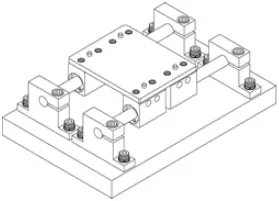
Example Image
Functions of Standard Linear Motion Mechanism
(1) Using two guide shafts in parallel effectively prevents workpiece rotation.
(2) Improved linear motion accuracy and load-bearing capacity.
(3) High-speed reciprocating motion can be achieved through the combination of guide shafts and linear bushings.
(4) Lower running resistance, resulting in less wear on the corresponding workpiece.
(1) Using two guide shafts in parallel effectively prevents workpiece rotation.
(2) Improved linear motion accuracy and load-bearing capacity.
(3) High-speed reciprocating motion can be achieved through the combination of guide shafts and linear bushings.
(4) Lower running resistance, resulting in less wear on the corresponding workpiece.
Actual Product Image
.jpg)
Functions of Key Components in the Mechanism
Application Industries


Related Products
| Linear Bushings Standard type Straight type | Bearing with Housing T-Shaped | Shaft Collar Slit | ||
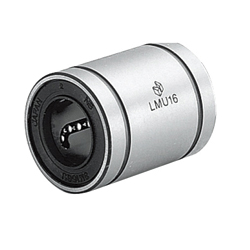 |  | 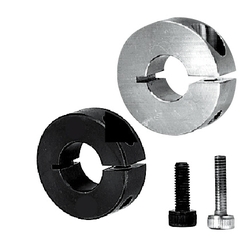 | ||
| Typical model: LMU8 | Typical model: BGHK6000ZZ-30 | Typical model: SCS8-10 |
Related Documents
For anti-rust performance of metal materials and surface treatment, click here.
here.
here.