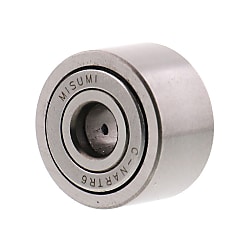
Roller Followers - Non Separate
Caution
- Download Free! >> Economy Series Catalog (TH-EN-FY25) CLICK here
Product Description
・ Product type: Roller Followers ・ Non-Separable type
・ This is an economy item; The price is cheaper than the MISUMI standard product.
・ Roller material: Made of SUJ2 Equivalent
・ Roller outer diameter D (Ø) [mm]: 16, 19, 24, 30, 32, 35, 40, 47
・ Roller inner diameter d (Ø) [mm]: 5, 6, 8, 10, 12, 15, 17, 20
・ Roller width B [mm]: 11, 14, 18, 20, 24
・ Model type: C-NARTR, C-NARTU, C-NARTV
Economy Roller Followers
- Constructed from high-quality SUJ2 equivalent steel, ensuring durability and long-term performance even in demanding environments.
- Designed to support substantial dynamic and static loads, with specified maximum capacities.
- The non-separable type is ideal for applications requiring a robust, maintenance-free solution with consistent performance.
- High-speed roller bearing
- Standardized dimensions and load capacities ensure precise performance and compatibility with various engineering designs.


MISUMI Standard

Cheaper Price

Product Variety

3D CAD Support
Since its outer ring rotates while being in direct contact with the mating surface, it is designed to withstand impact loads.
In addition, the outer ring is equipped with precision needle rollers (standard type) with a cage, providing excellent rotational performance and enabling high-speed rotation.
Roller followers are divided into two types: separable type (the inner ring, outer ring, and retaining ring can be separated) and non-separable type (the retaining ring is pressed onto the inner ring and cannot be separated).
The outer surface shape of the outer ring is available in arc type and cylindrical type. The arc-shaped outer ring easily absorbs shaft center deformation and helps reduce offset loads.
These products have a wide range of applications, such as cam mechanisms in automatic and special-purpose machine tools, various handling devices, transfer devices, bookbinding machines, tool changers in machining centers, pallet changers, automatic painting machines, and sliding forklifts in automated warehouses, among others.
Note: The packaging method for some models has changed. For d size ≤ 10, box packaging has been changed to bag packaging; for d size ≥ 12, blue box packaging has been changed to white box packaging. During the transition period, mixed shipments may occur, but this does not affect usage.

| Application | Arc type | Material | |
| With seal | Without seal | ||
| Standard type | C-NARTU | C-NARTR | Equivalent to SUJ2 |
| E-NARTUS | E-NARTRS | Equivalent to SUS440C | |
| High load type | C-NARTV | — | Equivalent to SUJ2 |
| E-NARTVS | E-NARTRVS | Equivalent to SUS440C | |
 Outer diameter tolerance 0 to -0.05 mmTypes of materials
This series is available in both bearing steel and stainless steel.
Compared to bearing steel, stainless steel has stronger rust resistance and is suitable for clean rooms and other environments where oil contamination must be avoided.
| Type | Roller Outer Diameter D | a | Roller Width B | B1 | r | Basic Rated Load | Rail Load Capacity | Maximum speed (rpm) | Weight (g) | |||||||
| C (dynamic) kN | Cor (static) kN | |||||||||||||||
 Type Type |  Roller inner diameter d Roller inner diameter d | Inner diameter tolerance | Standard type | High load type | Standard type | High load type | (kN) | Standard type | High load type | Standard type | High load type | |||||
| C-NARTU C-NARTV | 5 | 0 -0.008 | 16 | 12.5 | 11 | 12 | 0.15 | 3.15 | 4.9 | 3.3 | 6.5 | 0.86 | 14000 | 3800 | 14.5 | 15.1 |
| 6 | 19 | 15 | 3.5 | 5.4 | 3.9 | 7.9 | 1.1 | 11000 | 3100 | 20.5 | 21.5 | |||||
| 8 | 24 | 19 | 14 | 15 | 0.3 | 5.5 | 7.8 | 6.4 | 11.4 | 1.49 | 7500 | 2500 | 41.5 | 42.5 | ||
| 10 | 30 | 23 | 0.6 | 6.8 | 9.5 | 8.4 | 14.6 | 1.96 | 5500 | 2100 | 64.5 | 66.5 | ||||
| 12 | 32 | 25 | 6.9 | 9.7 | 8.8 | 15.4 | 2.19 | 4500 | 1800 | 71 | 73 | |||||
| 15 | 35 | 27.6 | 18 | 19 | 9.8 | 12.8 | 14.1 | 23 | 2.51 | 3600 | 1600 | 102 | 106 | |||
| 17 | 40 | 31.5 | 20 | 21 | 1 | 10.9 | 14.8 | 15.5 | 26.5 | 2.98 | 2900 | 1400 | 149 | 155 | ||
| 20 | 0 -0.01 | 47 | 36.5 | 24 | 25 | 15.5 | 20.6 | 25.5 | 42 | 5.72 | 3000 | 2400 | 250 | 255 | ||
| Type | Roller Outer Diameter D | a | Roller Width B | B1 | r | Basic Rated Load | Rail Load Capacity | Maximum speed (rpm) | Weight (g) | |||||||
| C (dynamic) kN | Cor (static) kN | |||||||||||||||
| Type | Roller inner diameter d | Inner diameter tolerance | Standard type | High load type | Standard type | High load type | (kN) | Standard type | High load type | Standard type | High load type | |||||
| E-NARTUS E-NARTVS | 5 | 0 -0.008 | 16 | 12 | 11 | 12 | 0.15 | 2.66 | 3.92 | 2.74 | 6.14 | 0.86 | 14000 | 4760 | 14.5 | 15.1 |
| 6 | 19 | 14 | 3.09 | 4.32 | 3.46 | 7.58 | 1.1 | 11200 | 3920 | 20.5 | 21.5 | |||||
| 8 | 24 | 17.5 | 14 | 15 | 0.3 | 4.86 | 6.24 | 5.37 | 11.48 | 1.49 | 9520 | 3080 | 41.5 | 42.5 | ||
| 10 | 30 | 23.5 | 0.6 | 6.33 | 7.6 | 6.1 | 13.32 | 1.96 | 8400 | 2800 | 64.5 | 66.5 | ||||
| 12 | 32 | 25 | 6.7 | 7.76 | 6.77 | 15.09 | 2.19 | 7280 | 2520 | 71 | 73 | |||||
■ Non-sealed type, bearing steel type
| Type | Roller Outer Diameter D | a | Roller Width B | B1 | r | Basic Rated Load | Track | Limit | Weight (g) | |||
| Type | Roller inner diameter d | Inner diameter tolerance | C (dynamic) kN | Cor (static) kN | Load capacity (kN) | Speed (rpm) | ||||||
| C-NARTR | 5 | 0 -0.008 | 16 | 12.5 | 11 | 12 | 0.15 | 3.15 | 3.3 | 0.86 | 20000 | 15 |
| 6 | 19 | 15 | 3.5 | 3.9 | 1.1 | 16000 | 21 | |||||
| 8 | 24 | 19 | 14 | 15 | 0.3 | 5.5 | 6.4 | 1.49 | 13600 | 42 | ||
| 10 | 30 | 23 | 0.6 | 6.8 | 8.4 | 1.96 | 12000 | 66 | ||||
| 12 | 32 | 25 | 6.9 | 8.8 | 2.19 | 4500 | 73 | |||||
| Type | Roller Outer Diameter D | a | Roller Width B | B1 | r | Basic Rated Load | Rail Load Capacity | Maximum speed (rpm) | Weight (g) | |||||||
| C (dynamic) kN | Cor (static) kN | |||||||||||||||
| Type | Roller inner diameter d | Inner diameter tolerance | Standard type | High load type | Standard type | High load type | (kN) | Standard type | High load type | Standard type | High load type | |||||
| E-NARTRS E-NARTRVS | 5 | 0 -0.008 | 16 | 12 | 11 | 12 | 0.15 | 2.66 | 4.9 | 2.74 | 6.14 | 0.86 | 20000 | 6800 | 14.5 | 15.1 |
| 6 | 19 | 14 | 3.09 | 5.4 | 3.46 | 7.58 | 1.1 | 16000 | 5600 | 20.5 | 21.5 | |||||
| 8 | 24 | 17.5 | 14 | 15 | 0.3 | 4.86 | 7.8 | 5.37 | 11.48 | 1.49 | 13600 | 4400 | 41.5 | 42.5 | ||
| 10 | 30 | 23.5 | 0.6 | 6.33 | 9.5 | 6.1 | 13.32 | 1.96 | 12000 | 4000 | 64.5 | 66.5 | ||||
| 12 | 32 | 25 | 6.7 | 9.7 | 6.77 | 15.09 | 2.19 | 4500 | 1800 | 71 | 73 | |||||
kgf = N × 0.101972As shown in diagram (1), non-separable roller followers are suitable for this scenario, while in diagram (2), separable roller followers are appropriate.

Note: When the side plate of a non-separable roller follower is subjected to axial force, it may shift or fall off. Please refer to the above diagram and select the appropriate model according to the application scenario.
■ Installation
When installing, make sure that the inner ring oil hole is not positioned in the load area; otherwise, it may shorten the service life to some extent.
■ Track load capacity
Track load capacity refers to the allowable load that the roller follower's outer ring can continuously withstand over a long period when in contact with the mating rail, without causing deformation or indentation of the rail.
The track load capacity listed in the parameter table is the value when steel with an applicable strength of 1.2 kN/mm² is used as the mating material. Therefore, when the hardness of the mating rail is not 40 HRC, the corresponding coefficient in the table below should be multiplied to obtain the correct allowable track load.

■ Dust Protection and Lubrication
1. The lubrication interval depends on operating conditions. As a general guideline, for standard types, replenish grease every 6 months to 2 years; for high-load types, replenish grease every 1 month to 6 months.
2. Even for products equipped with seals, excess grease may leak out during the initial operation phase or after replenishing the grease. If you wish to prevent grease from contaminating the area around the equipment, you can perform a trial run in advance and then wipe off any leaked excess grease.
3. As the usage time increases, the properties of the grease deteriorate and its lubricating performance decreases, so it is necessary to inspect and replenish the grease according to the frequency of use.
2. Do not drop or strike the roller follower. Otherwise, this may cause scratches or damage. Additionally, even if there is no visible damage after an impact, functional damage may still occur.
