Flat Belts for Sliding-Vertical Direction/Lateral Direction
Caution
Product Description
Flat Belts for Sliding-Vertical Direction/Lateral Direction
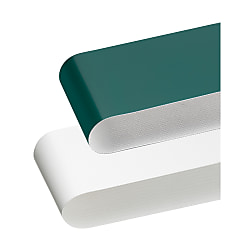
This conveyor belt is ideal for use in both vertical or lateral direction conveyor systems, with a wide range of sizes available to choose from.
[Feature]
● Belt Width Minimum / Maximum (mm.) : 10 mm. and 500 mm.
● Thickness (mm.): 0.5 mm. and 1.3 mm.
● Belt Length (m.) : The size is configurable between 0.5 to 20 m., and the minimum length can be increased by increments 0.01 m.
● Suitable for Minimum Pulley Belt Diameter Size (mm.) : 25 and 30
● Surface Cover Material: Urethane Impregnated and Polyester canvas
● Color: White and Green
[Application]
It is used in conjunction with pulleys to transfer materials in a conveyor system.
Flat Belts for Vertical and Lateral Sliding
Configurable flat belts for vertical-direction or lateral-direction transfer. Choose the belt type by direction; belt width W, circumference length L, color, thickness, allowable tension, minimum pulley diameter and continuous-use temperature are listed per type.
- SHBLTG and SHBLT are the vertical-direction types; YSBLGN and YSBLWN are the lateral-direction types.
- Circumference length is measured along the back surface of the belt as the inside circumference.
Types and components
Belt circumference is the length of the belt underside (inner circumference).
Flat belt tolerances
| Width tolerance | Thickness tolerance | Length tolerance | ||||
| Width | Tolerance | Thickness | Tolerance | Joint tolerance | Length | Tolerance |
|---|---|---|---|---|---|---|
| –400 | ±2 | –1.0 | ±0.1 | ±0.3 | –2000 | ±10 |
| 401–500 | ±3 | 1.1–1.5 | ±0.2 | 2001–7000 | ±20 | |
| 1.6–2.0 | 7001–10000 | ±0.3% | ||||
| 2.1–5.5 | ±0.4 | 10001– | ||||
Permanent belt elongation is max. 1% of the total length (reference).
| Type | Sliding direction | Color | Ply Quantity | Surface pattern | Material | Friction coefficient (reference value vs. polished steel) | Thickness mm | Unit mass kg/m² | Allowable tension N/mm (length direction) | Min. pulley dia. φmm | Knife Edge | Continuous use Temperature °C | ||
|---|---|---|---|---|---|---|---|---|---|---|---|---|---|---|
| Surface | Back | Front | Back | |||||||||||
| SHBLTG | Conveying direction | Green | 1 | - | Polyester impregnated | Polyester impregnated | 0.15 | 0.15 | 0.5 | 0.5 | 4 | 25 | R3 | -10– 80 |
| SHBLT | White | 1 | - | Polyester impregnated | Polyester impregnated | 0.15 | 0.15 | 0.5 | 0.5 | 4 | 25 | R3 | -10– 80 | |
| YSBLGN | Lateral | Green | 2 | - | Polyester canvas | Polyester canvas | 0.2 | 0.2 | 1.3 | 1.1 | 8 | 30 | × | -30–100 |
| YSBLWN | White | 2 | - | Polyester canvas | Polyester canvas | 0.2 | 0.2 | 1.3 | 1.1 | 8 | 30 | × | -30–100 | |
Ply number is the number of fabric layers in the belt. More layers give a higher allowable tension but a larger minimum pulley diameter.
| Type | Food hygiene | Antibacterial, antifungal | Prevents fraying | Water and humid heat resistance | Prevents heat shrinkage | Surface cleanability | Prevents rub-in shrinkage | Sodium hypochlorite resistance | Non-stick | Oil resistance |
|---|---|---|---|---|---|---|---|---|---|---|
| SHBLTG | ○ | - | - | △ | △ | △ | △ | △ | △ | △ |
| SHBLT | ○ | - | - | △ | △ | △ | △ | △ | △ | △ |
| YSBLGN | ○* | - | - | - | ○ | - | - | ○ | - | ○ |
| YSBLWN | ○ | - | - | - | ○ | - | - | ○ | - | ○ |
- *: Not suitable for conveying unwrapped oily or fatty foods.
◎: excellent, ◯: suitable, △: may be attacked, -: not suitable
Part numbers and dimensions
Ordering example
| Type | - | Circumference L (m) | |
|---|---|---|---|
| Type | Belt width | ||
| SHBLTG | 50 | - | 4.23 |
| Type | Circumference L (m) | |
|---|---|---|
| Type | Belt width W(mm) | Specified 0.01 m increments |
| SHBLTG SHBLT YSBLGN YSBLWN | 10 | 0.50–20.00 |
| 15 | ||
| 20 | ||
| 25 | 0.80–20.00 | |
| 30 | ||
| 35 | ||
| 40 | ||
| 50 | ||
| 60 | ||
| 70 | ||
| 75 | ||
| 80 | ||
| 90 | ||
| 100 | ||
| 110 | ||
| 120 | ||
| 125 | ||
| 130 | ||
| 140 | ||
| 150 | ||
| 160 | ||
| 170 | ||
| 180 | ||
| 190 | ||
| 200 | ||
| 210 | ||
| 220 | ||
| 230 | ||
| 240 | ||
| 250 | ||
| 260 | ||
| 270 | ||
| 280 | ||
| 290 | ||
| 300 | ||
| 310 | ||
| 320 | ||
| 330 | ||
| 340 | ||
| 350 | ||
| 360 | ||
| 370 | ||
| 380 | ||
| 390 | ||
| 400 | ||
| 410 | ||
| 420 | ||
| 430 | ||
| 440 | ||
| 450 | ||
| 460 | ||
| 470 | ||
| 480 | ||
| 490 | ||
| 500 | ||
The joint of SHBLTG and SHBLT may be about 0.3 mm thicker.
See below for how to calculate the length of flat belts used on MISUMI conveyors.
- *Formulas differ by conveyor. Always check the "Belt length formula" on the product page you use.
Formula example (GVHA): (2L+98)/1000, length unit: m
- *Rounded to 2 decimal places. L is the distance between conveyor pulleys. Example GVHA-30-500-25-T100-IM-5-D-AS: L = 500, (1000+98)/1000 = 1.1 (1.098 rounded)
Belt part number example: SHBLTG30-1.1
Technical information
- Below the minimum pulley diameter, the belt may slip on the pulley.
- Run the belt in the direction of the arrow printed on the body.