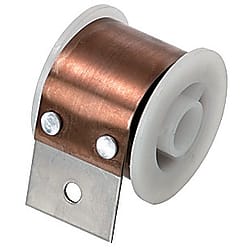
Constant Load Flat Coil Spring
Caution
- Please check the content on our website as the PDF does not contain the most up-to-date information.
Product Description
[Features]·This is a long plate spring bent at a constant curvature, and the return force (load) generated when it is stretched in a straight line is constant regardless of the stroke. ·Once the maximum load is reached, the load remains constant, no matter how much the stroke is extended. (Maximum output is reached only after the drum has rotated approx. 1/2.)
CFSB (Brackets for Constant Force Springs)

| [ M ]Material | |
| Main Body | Drum |
| SUS301EH | Polypropylene |
| [ M ]Material | [ S ]Surface Treatment | [ A ]Accessory | |
| Main Body | Shaft | Shaft | |
| SUS430 | SWCH Equivalent | Nickel Plating | Retaining Ring-C Type (SUS304) |
Basic Information
[Features]
- A long strip of material that is wound into a role.
When the strip is extended, the inherent stress resists the loading force at a constant rate. - Once it reaches the maximum load, the resistance is constant regardless of the stroke.
(The drums reach the max. output only after approximately half a rotation.)

Specifications/Overview
[How to Use]
1. The side on which a shaft goes through the drum is regarded as one end, and the accessory plate side as the other end.
Mount with screws using mounting holes of the accessory plate.
2. Can be used in either way of fixing the body and pulling out the accessory plate (Fig. 1) or fixing the accessory plate and
pulling out the body (Fig. 2).

[Cautions on Use]
1. A spring is coiled around a drum, but the inner edge of the spring is not fixed to the drum.
Do not pull out the stroke beyond the specified length: the spring may come off of the drum.
2. If a suitable load constant force spring can not be found, select a value one step higher and
adjust using a counterweight on the mating load.

3. Durability is as shown in specification table. A set of extension and contraction is counted as one cycle. If durability expectancy is exceeded, load capacity may decrease and cracks may appear partly on the spring surface. Continuous use under such condition is dangerous. If used in pairs, both will reach the end of their service life at the same time. Please replace both of them at the same time.
The above durability is for reference only. Actual durability may differ from the given value depending on factors such as the environment and conditions of use.
4. After prestressing of springs (5 ~ 10 sets of extension and contraction over the entire stroke) the load will be stable. Load capacity may be higher before prestressing.
1. Make sure the spring doesn't contact other structures.
2. Spring draw direction should be perpendicular to the shaft axis.
3. Make sure a spring doesn't contact the accessory plate when retracting.
4. Set the spring so that it can be pulled out horizontally at any time in order to avoid deflection (bending).
5. If drum and shaft do not rotate smoothly, the spring will deteriorate due to excessive force.
6. When using brackets, orient them in the position as shown in Fig. 3. Orienting them in the position as shown in Fig. 4 may cause the spring to come into contact with the installation surface of the brackets. This may allow foreign objects such as dust inside, which can cause the spring to deteriorate.

7. When the spring's direction of movement is changed n times by idlers, etc., the service life is approximately 1/(n+1) times lower because the spring deforms more often. In particular, when making a sharp change in direction or under conditions where repeated stress is concentrated on the same part of the spring, the life may become even shorter.
8. When the direction of the spring is changed with an idler, etc., design as shown in Figure 5.

Spring outer diameter ≤ Idler outer diameter
(Fig. 5)

Spring outer diameter > Idler outer diameter
(Fig. 6)
Idler direction is opposite to spring winding direction
(Fig. 7)