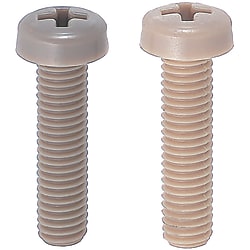
Plastic Cross Recessed Pan Head Screws - Pkg. / Small Box
Brand :
MISUMI
Caution
- Heat and chemical resistances vary depending on the condition of use. Be sure to test the product before use under expected application conditions.
- The color may change depending on production lot and other conditions.
Product Description
[Features]· The surface colors of plastic Phillips pan head screws may change somewhat depending on production lot and other conditions.· Sometimes black spots on the surface may be seen, which does not affect its performance.
[Materials] PPS (Polyphenylenesulfide), PEEK (Polyetheretherketone).
[Thread Type] Metric, Coarse.
[Nominal of Thread (M)] 2.6, 3, 4, 5, 6.

[!]100 pcs. per pkg.
[ ! ] The surface colors of plastic cross recessed pan head screws may change somewhat depending on production lot and other conditions.
[ ! ] Sometimes black spots on the surface may be seen, which does not affect its performance.
| Type | Material | Color |
| PACK−PPSA | PPS (Polyphenylenesulfide) | 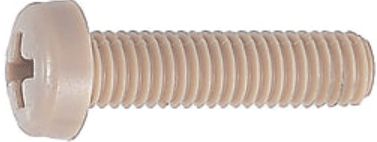 |
| PACK−PEKS | PEEK (Polyetheretherketone) | 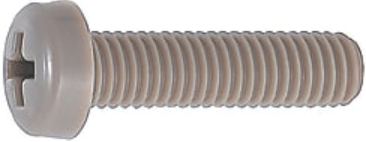 |
Product Specifications
| Material | Features |
| RENY - Glassfiber Reinforced Polyamide MXD6 (Glassfiber Reinforced Polyamide MXD) | RENY is based on polyamide MXD6 and is also a crystalline engineered plastic reinforced with 50% glass fiber. It has the highest strength and elasticity among engineered plastics, and excels in both oil and heat resistance. Thus, it is used as an alternative to metal. |
| PPS - Polyphenylenesulfide (Polyphenylenesulfide) | PPS is a crystalline super engineered plastic. It has excellent heat resistance, and does not deteriorate in physical properties even when it is used for long durations in high temperature atmosphere. It excels in chemical resistance, mechanical characteristics, electrical properties and dimensional stability. |
| PEEK - Polyetheretherketone (Polyetheretherketone) | PEEK is semicrystalline super engineered plastic with the highest performance. It has the highest chemical resistance among all engineered plastics. The only generally used chemical that can dissolve PEEK is concentrated sulfuric acid. PEEK also excels in heat resistance, abrasion resistance, flame resistance and hydrolysis resistance. |
■Mechanical Properties (Reference)
| Tensile Breaking Load N | Torsional Breaking Torque N⋅m | |||
| PACK−PPSA | PACK−PEKS | PACK−PPSA | PACK−PEKS | |
| M2.6 | 440 | 312 | 0.19 | 0.16 |
| M3 | 570 | 430 | 0.36 | 0.3 |
| M4 | 980 | 765 | 0.71 | 0.64 |
| M5 | 1570 | 1230 | 1.42 | 1.28 |
| M6 | 2250 | 1670 | 2.11 | 2.26 |
Recommended tightening torque is torsional sheer torque × 50%.
Use a torque driver and torque wrench for tightening.
Mechanical characteristics change depending on the operating environment.
Testing the product before use under actual usage state is recommended.
■Guideline for Selection of Plastic Screws by Material (1)
◎: Excellent○: Good△: Questionable
| Item | RENY | PPS | PPS Non-Glass Fiber | PEEK |
| Lightness | △ | △ | ○ | ○ |
| Water Absorption Stability | ◎ | ◎ | ◎ | △ |
| Strength, Rigidity | ◎ | ◎ | ○ | ○ |
| Impact Resistance | ◎ | ○ | ○ | ○ |
| Friction Resistance, Abrasion Resistance | ◎ | ◎ | ◎ | ◎ |
| Heat Resistance | △ | ◎ | ◎ | ◎ |
| Flame Resistance | △ | ◎ | ◎ | ◎ |
| Electrical Properties | ○ | ◎ | ◎ | ◎ |
| Weather Resistance | ○ | ○ | ○ | ◎ |
■Guideline for Selection of Plastic Screws by Material (2)
·RENY and PPS contains glass fiber.
·Continuous Use Temperature RENY: 105°C PPS / PPS Non-Glass Fiber: 200°C PEEK: 180°C
·Combustibility RENY: UL94HB PPS / PPS Non-Glass Fiber / PEEK: UL94 V−0
| Strength | RENY > PPS > PEEK > PPS Non-Glass Fiber |
| Heat Resistance | PPS / PPS Non-Glass Fiber > PEEK > RENY |
| Chemical Resistance | PEEK > PPS / PPS Non-Glass Fiber > RENY |
·Continuous Use Temperature RENY: 105°C PPS / PPS Non-Glass Fiber: 200°C PEEK: 180°C
·Combustibility RENY: UL94HB PPS / PPS Non-Glass Fiber / PEEK: UL94 V−0
■Physical Properties Table (Reference) (Reference)
[ ! ] Values shown in tables are reference, and not guaranteed.
| Characteristics | Testing Method (ASTM) | Unit | RENY | PPS | PPS Non-Glass Fiber | PEEK |
| [Mechanical Characteristics] | ||||||
| Tensile Strength | D638 | MPa | 285 | 196 | 90 | 91 |
| Elongation | D638 | % | 2.1 | 2.2 | — | 50 to 120 |
| Bending Strength | D790 | MPa | 380 | 255 | 140 | 147 |
| Flexural Modulus | D790 | GPa | 17.4 | 13.2 | 3.8 | 3.9 |
| Izod Impact Strength | D256 | J/m | 110 | 98 | — | 88 |
| (Notched) | ||||||
| Rockwell Hardness | D785 | R/M Scale | M111 | M110 | — | R126 |
| [Thermal Characteristics] | ||||||
| Deflection Temperature under Load | D648 | °C | 234 | 270 | 100 | 152 |
| (1.82 Mpa) | ||||||
| Linear Expansion Coefficient | D696 | 10−5/K | 1.5 | 1 | — | 5 |
| [Electrical Characteristics] | ||||||
| Dielectric Constant | D150 | — | 4 | 4.6 | 3.6 | 3.3 |
| (106 Hz) | ||||||
| Dielectric Tangent | D150 | — | 0.009 | 0.002 | 0.001 | 0.004 |
| (106 Hz) | ||||||
| Volume Resistivity | D257 | Ω·cm | 1.0 × 10⁹ | 1.0 × 10¹⁶ | 2.0 × 10¹⁶ | 4.9 × 10¹⁶ |
| Dielectric Breakdown Strength | D149 | MV/mm | 17 | 12 | — | 17 |
| Arc Resistance | D495 | sec | 129 | 120 | — | 23 |
| [Others] | ||||||
| Specific Gravity | D792 | — | 1.65 | 1.66 | 1.35 | 1.3 |
| Water Absorption | D570 | % | 0.14 | 0.015 | 0.02 | 0.5 |
| (23°C underwater × 24 h) | ||||||
| Fiber Glass Content | — | % | 50 | 40 | — | — |
■Chemical Resistance Data (Reference) (Reference)
◎: Not Affected○: Hardly Affected△: Somewhat Deteriorated
[ ! ] Chemical resistances vary depending on the condition of use.
Be sure to test the product before use under expected application conditions.
| Chemical Name | Temperature | RENY | PPS PPS Non-Glass Fiber | PEEK |
| Hydrochloric Acid 10% | 80°C | × | ○ | ◎ |
| Hydrochloric Acid 10% | Ambient Temperature | × | ◎ | ◎ |
| Nitric Acid 10% | 80°C | × | △ | ◎ |
| Nitric Acid 10% | Ambient Temperature | × | ◎ | ◎ |
| Sulfuric Acid 30% | 80°C | × | ○ | ○ |
| Sulfuric Acid 10% | 80°C | × | ○ | ○ |
| Sulfuric Acid 10% | Ambient Temperature | × | ◎ | ○ |
| Sodium Hydroxide 30% | 80°C | △ | ○ | ◎ |
| Sodium Hydroxide 10% | Ambient Temperature | ○ | ◎ | ◎ |
| Calcium Chloride (Saturation) | 80°C | △ | ◎ | ◎ |
| Acetone | Ambient Temperature | ○ | ◎ | ◎ |
| Methanol | 60°C | ○ | ◎ | ◎ |
| Gasoline | Ambient Temperature | ○ | ◎ | ◎ |
| Light Oil | Ambient Temperature | ○ | ◎ | ◎ |
| Motor Oil | 80°C | ○ | ◎ | ◎ |
| Gear Oil | 100°C | ○ | ◎ | ◎ |
[ ! ] Chemical resistances vary depending on the condition of use.
Be sure to test the product before use under expected application conditions.